Moon Sweepers collect lunar dust: Beginner Guide
Learn how lunar dust collection, depot shipments, upgrades, and 16-player co-op work in Moon Sweepers with this prelaunch beginner guide.
How Lunar Dust Collection Works in Moon Sweepers
An entire lunar surface and one toothbrush: that is the wonderfully impractical starting point behind Moon Sweepers collect lunar dust searches. Understanding the collection-and-shipping loop matters because dust funds the equipment that helps your cleanup operation grow. This Moon Sweepers collect lunar dust guide explains the confirmed mechanics and offers practical planning tips without pretending there is already a tested, best-in-slot upgrade route.
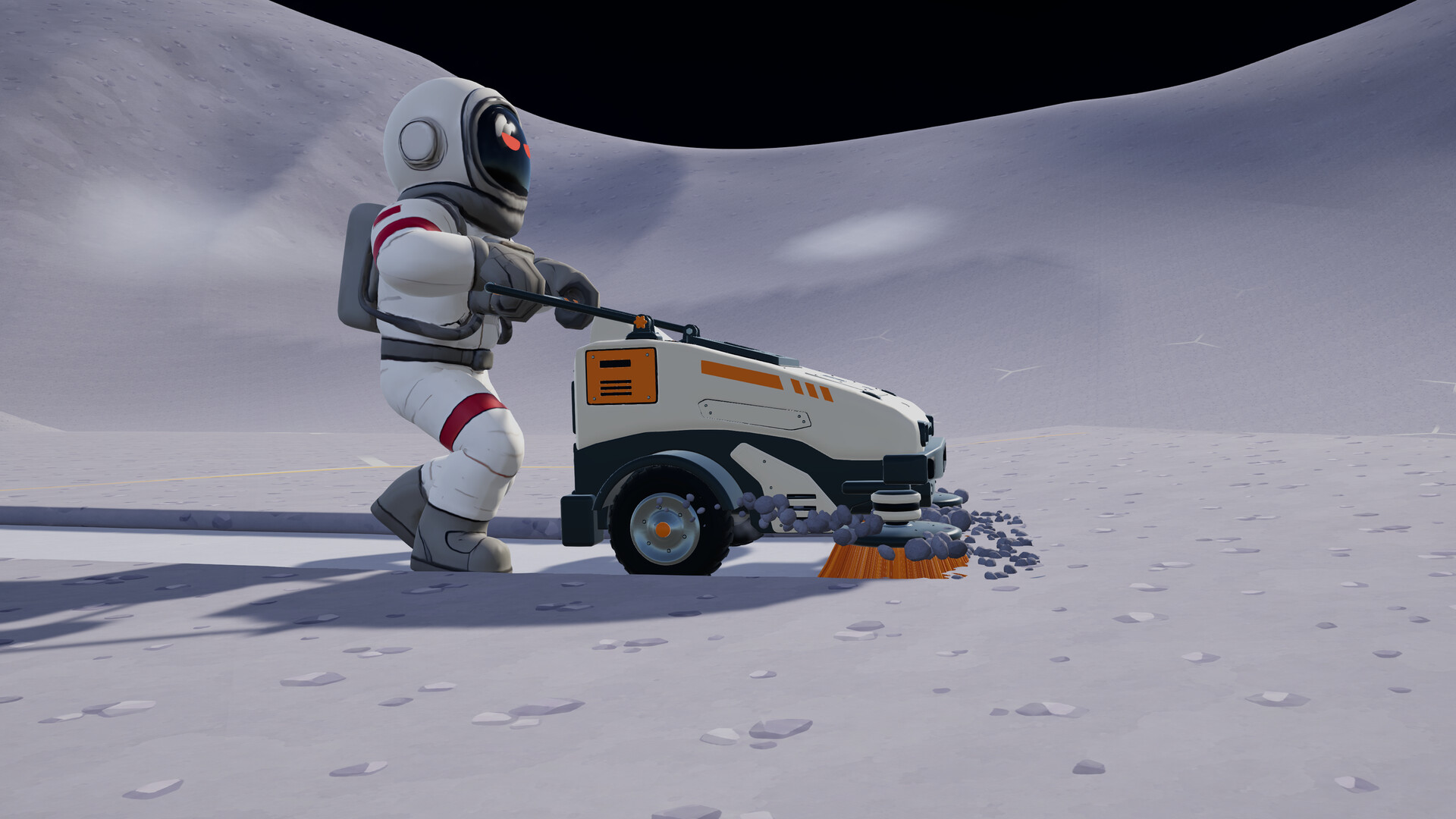
Official screenshot · Source: Steam store
Prelaunch note: As of October 20, 2026, Moon Sweepers is scheduled to launch on Steam on October 23, 2026. The information below comes from its official store description and developer announcement, not hands-on testing. Exact controls, equipment prices, collection rates, and shipment timing remain unconfirmed in those materials.
The premise is simple: the Lunar Surface Department has assigned your crew an enormous cleaning job with very little starting equipment. Your initial toothbrush is only the beginning. Collected dust becomes income, which you can reinvest in tools, carrying capacity, and eventually cleaning vehicles.
| Feature | Confirmed information | Why it matters |
|---|---|---|
| Starting equipment | A toothbrush | Your initial operation begins with basic cleaning equipment |
| Main resource | Lunar dust | Collecting and selling it funds progression |
| Payment process | Deliver dust to a depot and launch shipments | Collection alone is not the complete earning loop |
| Equipment progression | Better tools and increased carrying capacity | Upgrades support larger cleanup jobs |
| Operation expansion | Placeable depots and cleaning vehicles | Your setup can grow beyond the starting routine |
| Multiplayer | Solo play or online co-op for up to 16 players | You can work independently or organize a crew |
The official Moon Sweepers Steam listing is the authoritative reference for these features and the planned release date.
Moon Sweepers Collect Lunar Dust: The Basic Gameplay Loop
The most useful way to understand progression is as a repeating cycle:
Clean terrain → collect dust → deliver to a depot → launch a shipment → spend earnings → repeat.
The official description specifically distinguishes filling storage, delivering dust, and launching shipments. Treat those as separate stages when planning your work rather than assuming you get paid immediately after brushing the ground.
1. Start with a manageable cleaning area
Use the starting toothbrush to work through a small patch of dusty terrain. The game advertises visible surface changes as you clean, giving you a way to see where you have already worked.
A sensible first-session approach is to finish a recognizable patch before moving farther away. That is an organizational suggestion, not a confirmed bonus mechanic: the published materials do not mention rewards for completing individual sections.
2. Gather dust into your storage
Your collected lunar dust fills storage. Increased carrying capacity is a confirmed upgrade, so storage size will be part of the progression loop.
Initially, pay attention to how often you need to interrupt cleaning for deliveries. That observation should help you decide whether you need more capacity or a better cleaning tool.
3. Deliver and ship your collection
Bring your dust to a depot, then launch a shipment to receive payment. The available descriptions do not establish exact interface prompts, automatic shipping behavior, or shipment delays.
For your first delivery, learn the entire process before settling into a long cleaning session. Confirm how depositing and shipping work in the released game rather than relying on an assumed interaction key.
4. Reinvest in the next round
Spend earnings on equipment that addresses your biggest slowdown.
| Stage | What to do | What to observe |
|---|---|---|
| Clean | Work a clearly defined patch | How quickly the tool clears terrain |
| Collect | Build up your dust load | How frequently storage fills |
| Deliver | Return to a depot | How much time the trip takes |
| Ship | Launch the collected dust | How payment is triggered |
| Upgrade | Improve your equipment | Whether the purchase reduces your main delay |
For anyone researching Moon Sweepers collect lunar dust, this complete cycle matters more than collection alone. A productive cleaning session also needs a practical delivery routine.
Upgrade Planning: Tools, Capacity, and Cleaning Vehicles
There is no verified best upgrade order yet. Neither supplied source lists item costs, tool statistics, vehicle specifications, or an unlock tree.
Instead of treating an untested shopping list as fact, use a simple rule: upgrade the part of the operation that is slowing you down most.
Choose between faster cleaning and larger loads
Better tools and increased carrying capacity address different problems.
If brushing feels slow but your storage rarely fills, a stronger cleaning tool is a reasonable purchase to investigate. If you constantly stop working because you are carrying a full load, additional capacity deserves a closer look.
This is a decision framework based on the announced mechanics, not a proven optimization strategy.
| What you notice | Upgrade or change to consider | Reasoning |
|---|---|---|
| Cleaning takes most of your time | Better cleaning tools | Tool progression is intended to improve your equipment |
| Storage fills before you finish a small area | Increased carrying capacity | Larger loads let you handle more dust between deliveries |
| Delivery trips dominate your session | A depot nearer the work area | Shorter routes may reduce time spent traveling |
| Your operation covers larger areas | Cleaning vehicles as they become available | Vehicles are part of the announced expansion path |
| You are unsure what is inefficient | Observe another collection-and-shipping cycle | A little measurement can prevent an unhelpful purchase |
Compare complete cycles, not just brush speed
For Moon Sweepers collect lunar dust planning, consider how much time goes into a complete shipment, not just how quickly you can scrub.
Imagine two hypothetical sessions. In one, you clean for six minutes and spend four minutes handling deliveries. In another, you clean for eight minutes and spend two minutes on deliveries. Both take ten minutes, but the second leaves more time for collection.
Those numbers illustrate the planning principle; they are not measured Moon Sweepers results. Actual efficiency will depend on the released tools, storage limits, travel conditions, and shipping mechanics.
Treat vehicles as an expansion option
Cleaning vehicles are confirmed, but their names, prices, handling, and relative performance are not detailed in the supplied references.
Do not assume the first vehicle will automatically be the best purchase available. Once the game launches, compare its cost and usefulness against your current tools, capacity, and delivery setup.
Depot Placement and Co-op Organization
Depots connect your cleaning work to payment. The official description says you can place them near your work, making location a practical part of your operation.
For a Moon Sweepers collect lunar dust strategy, start by thinking about the journey between the dirty terrain and the drop-off point.
Keep the delivery route easy to understand
A useful starting plan is to choose a work area near a depot and expand outward. When your active cleaning area moves farther away, reassess whether a closer depot would help.
The available information does not establish depot placement costs, placement restrictions, or whether existing depots can be relocated. Check those details in-game before committing to a large layout.
Useful questions include:
- Can you easily find the depot from your current work area?
- Are you spending more time traveling than cleaning?
- Would another depot serve the next area better?
- Does your crew understand which depot it is using?
These questions help identify logistical problems without assuming hidden mechanics.
Divide the Moon into simple work zones
Moon Sweepers supports online co-op lobbies of up to 16 players total. The developer describes both spreading out and cleaning an area together as supported approaches.
A full lobby does not guarantee an efficient one. Clear assignments can make it easier to see what is finished and where people should go next.
| Crew approach | Suggested organization | Potential benefit |
|---|---|---|
| Solo | Work one nearby patch at a time | Keeps your route and progress easy to follow |
| Small group | Give each player a neighboring section | Reduces confusion about unfinished terrain |
| Medium group | Establish a shared work area and depot | Makes regrouping and deliveries simpler |
| Large lobby | Divide into smaller groups with distinct zones | Helps coordinate a crew of up to 16 |
These are suggested organizational methods, not tested team-size rankings.
Avoid assuming shared hauling or money
The references confirm multiplayer cleaning, but they do not explain whether players can transfer dust between inventories, specialize as haulers, or share earnings automatically.
Until those systems are verified, coordinate around confirmed activities: selecting areas, cleaning terrain, and understanding delivery locations. If launch-day mechanics support more specialized roles, you can build a more elaborate crew routine then.
First-Session Checklist and Mistakes to Avoid
Use your opening session to learn the economy before trying to optimize it. One completed collection-and-shipping cycle should answer more practical questions than wandering across the lunar surface with a full load.
This Moon Sweepers collect lunar dust checklist keeps the early priorities straightforward:
- Clean a small, identifiable patch. Watch how the surface changes.
- Observe your storage. Learn how the game communicates your current load.
- Find and use a depot. Complete the delivery process.
- Launch a shipment. Confirm how you receive payment.
- Review available upgrades. Compare actual prices and descriptions.
- Address one clear slowdown. Avoid buying purely because an item looks more advanced.
- Repeat and reassess. See whether your new setup improves the full cycle.
Common planning mistakes
Focusing only on collection speed. A faster tool may not solve frequent delivery interruptions. Consider the whole loop.
Spreading out without a plan. Exploration may be enjoyable, but an organized cleanup crew benefits from knowing where everyone is working.
Assuming automation from store tags. User-defined tags are not a substitute for detailed feature documentation. The supplied descriptions confirm depots and vehicles, not a fully automated production network.
Treating prerelease advice as tested fact. Specific earnings-per-minute claims, exact upgrade rankings, and detailed control instructions would go beyond the available evidence.
For Moon Sweepers collect lunar dust progression, the strongest starting habit is simple: notice what interrupts useful work, then investigate the upgrade or layout change that addresses it.
FAQ
How do you collect lunar dust in Moon Sweepers?
You start with a toothbrush and clean dusty lunar terrain. Collected dust fills your storage; you then deliver it to a depot and launch shipments for payment. This is the confirmed loop behind Moon Sweepers collect lunar dust guides, although exact controls are not provided in the prerelease references.
What should you upgrade first?
There is no verified best first upgrade as of October 20, 2026. Consider better tools if cleaning is your main slowdown, or increased carrying capacity if frequent full loads interrupt your work. Check actual prices and equipment descriptions after launch.
Can you play Moon Sweepers alone?
Yes. The official listing confirms single-player support as well as online co-op for up to 16 players. Playing solo does not require organizing a crew, while multiplayer lets you divide the cleaning area or work together.
When does Moon Sweepers release?
Moon Sweepers is scheduled to release on Steam on October 23, 2026. As of this guide’s October 20 publication date, it has not launched. Its store page is the best place to check for schedule changes and updated gameplay information.
Related Guides
Moon Sweepers carrying capacity: Upgrade Guide
Learn how Moon Sweepers carrying capacity upgrades fit into dust collection, depot deliveries, and smarter progression before launch.
Moon Sweepers cleaning tools: Upgrade Guide
Explore Moon Sweepers cleaning tools, the starting toothbrush, dust sales, capacity upgrades, and vehicle progression in this prerelease guide.
Moon Sweepers cleaning vehicles: Progression Guide
Learn what’s confirmed about Moon Sweepers cleaning vehicles, how dust sales support progression, and how to plan upgrades before launch.
Moon Sweepers developer: DragDrop Games Launch Guide
Meet Moon Sweepers developer DragDrop Games and explore the October 23 Steam release, 16-player co-op, gameplay, and PC requirements.
Moon Sweepers co-op lobbies: 16-Player Guide
Explore Moon Sweepers co-op lobbies, the 16-player limit, cleaning progression, launch details, and practical tips for organizing your crew.