Moon Sweepers online co-op: 16-Player Crew Guide
Explore Moon Sweepers online co-op, its 16-player limit, cleanup progression, PC requirements, and practical tips for planning your lunar crew.
What Is Moon Sweepers Online Co-op?
An entire Moon, a toothbrush, and a crew of friends: Moon Sweepers online co-op turns a wildly underfunded cleaning assignment into a multiplayer operation. If your group wants a cooperative game built around visible progress and equipment upgrades, Moon Sweepers online co-op is worth watching. The key is knowing what its 16-player sessions promise—and which multiplayer details remain unconfirmed before launch.
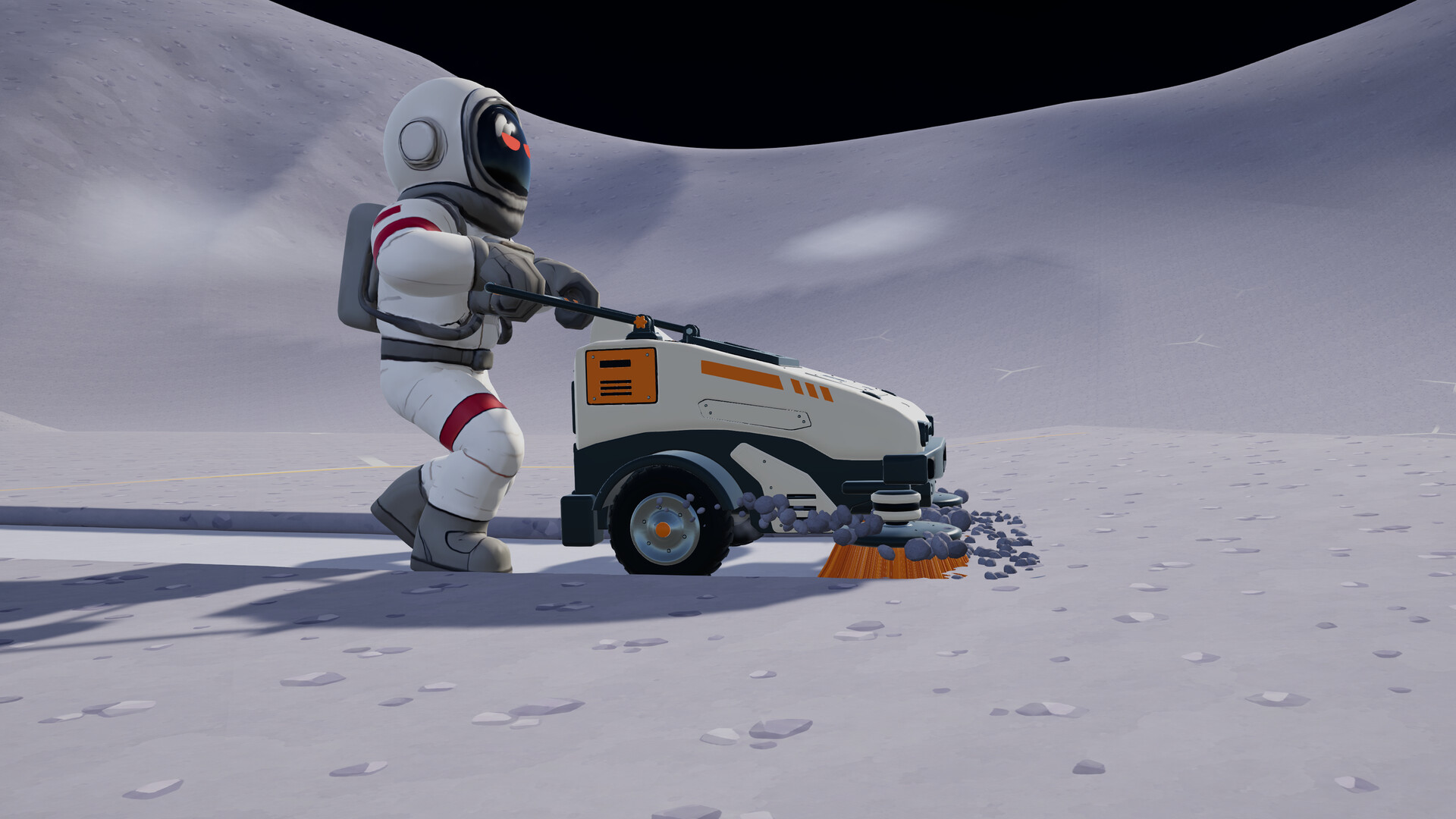
Official screenshot · Source: Steam store
Developed and published by DragDrop Games, Moon Sweepers puts you to work for the Lunar Surface Department. Your job is to collect lunar dust, ship it away for payment, and reinvest the proceeds in equipment that makes cleaning less painfully slow.
As of October 20, 2026, the game is scheduled to launch on Steam on October 23, 2026. This guide covers announced features and planning suggestions, not hands-on impressions or verified launch-day performance.
| Feature | Confirmed information |
|---|---|
| Online multiplayer | Co-op lobbies supporting up to 16 players |
| Solo play | Single-player supported |
| Starting equipment | A toothbrush |
| Main activity | Collecting and selling lunar dust |
| Progression | Better cleaning tools, increased carrying capacity, and cleaning vehicles |
| Infrastructure | Placeable depots near work areas |
| Planned release | October 23, 2026, on Steam |
The official Moon Sweepers Steam page is the authoritative place to check release status, listed features, and system requirements.
How the 16-Player Co-op Works
The central draw of Moon Sweepers online co-op is its 16-player lobby limit. That is the maximum total crew size, not you plus 16 additional teammates.
The developer describes two ways to approach the job: spread out to clean different areas or work together on the same patch of terrain. Both suit the basic premise, but they create different coordination needs.
A small group can stay close and make decisions informally. A larger crew may benefit from agreeing on work areas and delivery priorities before everyone heads off in a different direction.
Pick a crew size that fits your group
You do not need a full lobby to participate. Solo play is explicitly supported, and the multiplayer description allows crews of up to 16.
The following are planning suggestions, not tested efficiency rankings or separate game modes:
| Crew size | Suggested approach | Coordination priority |
|---|---|---|
| 1 player | Handle collection, delivery, and upgrades yourself | Keep work areas manageable |
| 2–4 players | Clean nearby patches and discuss purchases together | Avoid unnecessary overlap |
| 5–8 players | Divide into a few informal work groups | Agree on areas and depot locations |
| 9–16 players | Use clearly identified cleaning zones | Keep communication easy to follow |
More players mean more potential hands on the job, but there is no published evidence establishing how quickly a full crew progresses compared with a smaller one. Avoid assuming that 16 players will produce exactly 16 times the output.
Know what is still unconfirmed
The supplied announcements establish lobby capacity, but they do not explain the complete hosting and invitation process.
They also do not establish:
- Dedicated server availability.
- Public matchmaking or lobby-browser options.
- Drop-in and drop-out behavior.
- Host migration.
- How money, upgrades, and world progress are assigned.
- Whether progress transfers between different hosts.
- Console cross-play or local split-screen support.
These details matter if your group plans to maintain one long-running cleanup operation. Before committing to a regular session schedule, check how ownership and saving work in the released game.
The Cleanup Loop: Dust, Deliveries, and Upgrades
Moon Sweepers online co-op is built around a straightforward progression cycle: remove dust, fill your storage, deliver the material to a depot, launch a shipment, and spend the proceeds.
The toothbrush establishes the deliberately modest starting point. Better tools, larger carrying capacity, and cleaning vehicles provide the longer-term progression.
Crucially, cleanup is visible. Terrain becomes cleaner as you work, giving the crew a direct way to see what it has accomplished.
| Stage | What the developer confirms | Practical question for your crew |
|---|---|---|
| Collect | Gather dust from the lunar surface | Which patch are we working on? |
| Carry | Store collected dust within your carrying capacity | Are frequent deliveries interrupting work? |
| Deliver | Bring dust to a depot | Is the depot conveniently located? |
| Ship | Launch shipments to receive payment | Are we completing the delivery process? |
| Upgrade | Purchase better tools and more capacity | What is slowing our current work? |
| Expand | Place depots and use cleaning vehicles | Where should the operation grow next? |
Choose upgrades around the current bottleneck
There are no confirmed upgrade prices, exact tool statistics, or tested optimal purchase orders in the supplied material. Any claim that one upgrade is always the best first buy would therefore be premature.
Instead, use a simple decision rule:
- Cleaning feels slow: inspect the available tool improvements.
- Storage fills too quickly: consider increased carrying capacity.
- Deliveries interrupt every short cleaning stretch: review depot placement.
- Your work area has expanded: investigate how available vehicles fit the job.
This approach keeps spending tied to an observable problem rather than an assumed progression guide.
For example, a crew that spends most of its time returning to a distant depot should examine delivery logistics before automatically prioritizing another cleaning tool. That is a planning principle, not a measured claim about the game’s economy.
Treat depots as part of your work plan
The developer explicitly allows players to place depots near their work. That makes location relevant to how your cleanup operation develops.
Before expanding into another patch, ask where collected dust will go. A nearby delivery point may make a work area more convenient, while a poorly positioned one could leave everyone repeating an awkward route.
Exact construction costs, placement restrictions, and depot limits are not established by the reference material. Check those details in-game before planning a sprawling network.
Practical Tips for Your First Multiplayer Session
A little organization should help your Moon Sweepers online co-op group spend less time debating and more time cleaning. These are launch-session suggestions based on the announced mechanics, not strategies validated through player testing.
Start together before spreading out
Use the opening stretch to understand collection, storage, shipping, and purchasing. Staying near one another initially makes it easier to compare what each player sees and clarify unfamiliar systems.
Once the group understands the basics, choose whether to continue cleaning together or divide into neighboring areas.
Avoid assigning rigid specialist roles immediately. The announcements do not establish a formal class system or confirm that one player can handle every logistical task on behalf of everyone else.
Make work areas easy to describe
“Clean over there” becomes less useful as the lobby gets bigger. Pick visible reference points and agree on simple descriptions for your current patches.
An informal plan might look like this:
- One group works beside the current depot.
- Another starts on the adjacent dusty area.
- Everyone checks in before shifting to a new location.
- The crew reviews its next purchase after completing shipments.
These are communication habits, not built-in assignment features.
Verify multiplayer rules before a long session
Because progression ownership is unconfirmed, your first session should answer a few practical questions before anyone invests hours.
| First-session check | What to establish | Why it matters |
|---|---|---|
| Hosting and joining | How players enter the same lobby | Prevents avoidable setup confusion |
| Purchase behavior | Who can buy equipment and who receives it | Helps the group plan spending |
| Saving | What is saved and whose session owns it | Clarifies how to resume later |
| Rejoining | What happens when someone leaves and returns | Helps accommodate interruptions |
| Larger-group performance | How your actual setup handles more players | Tests conditions relevant to your crew |
Steam lists Save Anytime as an accessibility feature, but that does not explain every multiplayer persistence rule. Check the actual behavior rather than assuming all participants retain identical progress.
Use visible progress as a session goal
A concrete cleaning target can be easier to coordinate than an open-ended instruction to earn money.
For example, agree to finish a nearby patch, complete deliveries, and then discuss the next upgrade. That gives casual players a clear stopping point without inventing mission objectives the developer has not announced.
PC Requirements and Launch Preparation
Before organizing Moon Sweepers online co-op, have each participant compare their PC with the published requirements. The Steam listing specifies Windows configurations, a 64-bit processor and operating system, broadband internet, and 2 GB of available storage.
| Component | Minimum | Recommended |
|---|---|---|
| Operating system | Windows 10 | Windows 11 |
| Processor | Intel Core i5-8400 / AMD Ryzen 5 2600 | Intel Core i5-10400 / AMD Ryzen 5 3600 |
| Memory | 8 GB RAM | 8 GB RAM |
| Graphics | NVIDIA GeForce GTX 1650 / AMD Radeon RX 570 | NVIDIA GeForce GTX 1660 Super / AMD Radeon RX 5600 XT |
| DirectX | Version 11 | Version 12 |
| Network | Broadband internet | Broadband internet |
| Available storage | 2 GB | 2 GB |
These specifications are not a guarantee of a particular frame rate, resolution, or 16-player performance level. The supplied sources contain no multiplayer benchmarks.
Steam Deck compatibility is listed as unknown. Do not treat controller listings or modest storage requirements as proof of Steam Deck verification.
For launch preparation:
- Confirm the game has released before scheduling the session.
- Check each player’s hardware against the requirements.
- Review the available hosting and joining options.
- Test a short session before organizing a full 16-person gathering.
- Agree on whose saved operation the group intends to continue, once the saving rules are clear.
The concept is appealing for friends who enjoy cooperative chores, incremental upgrades, and a deliberately silly setting. Whether the pacing, networking, and progression remain satisfying over longer sessions will require hands-on assessment after release.
FAQ
How many players can join Moon Sweepers online co-op?
Moon Sweepers supports online co-op lobbies of up to 16 players total. You can spread out across different work areas or clean the same area together. The game also supports single-player.
When does Moon Sweepers release?
The planned Steam release date is October 23, 2026. As of this article’s October 20, 2026 publication date, the game has not yet launched. Check the Steam listing for any schedule changes.
Does Moon Sweepers support cross-play or split-screen?
The supplied official information confirms online co-op but does not confirm console cross-play or local split-screen. Neither should be assumed from the online multiplayer listing.
Do all players keep their co-op progress?
That is not established in the supplied material. Steam lists saving-related features, but those do not specify how multiplayer world ownership, earnings, or upgrades persist for each participant. Verify those rules before starting a long-term crew save.
Related Guides
Moon Sweepers 16 players: Co-op Features and Tips
Explore Moon Sweepers' 16-player online co-op, October 23 release plans, cleaning progression, PC requirements, and practical crew-planning tips.
Moon Sweepers co-op lobbies: 16-Player Guide
Explore Moon Sweepers co-op lobbies, the 16-player limit, cleaning progression, launch details, and practical tips for organizing your crew.
Moon Sweepers multi-player: 16-Player Co-op Guide
Explore Moon Sweepers multi-player, including its 16-player co-op limit, cleanup progression, PC requirements, and what remains unconfirmed.
Moon Sweepers carrying capacity: Upgrade Guide
Learn how Moon Sweepers carrying capacity upgrades fit into dust collection, depot deliveries, and smarter progression before launch.
Moon Sweepers developer: DragDrop Games Launch Guide
Meet Moon Sweepers developer DragDrop Games and explore the October 23 Steam release, 16-player co-op, gameplay, and PC requirements.